Tactile perception is essential for dexterous manipulation, yet high-resolution elastomer simulation remains computationally expensive. FEM offers high fidelity but requires costly remeshing, while MPM incurs significant memory overhead. We present a reduced-order neural simulation framework that combines coarse-grained MPM with an implicit neural decoder to recover fine tactile deformations from compact latent states. By learning a continuous deformation manifold from paired high- and low-resolution simulations, the model enables physically consistent and differentiable inference. Compared with TacIPC, our method achieves 65% faster simulation and 40% lower memory usage while improving geometric fidelity. It further improves tactile rendering and 3D reconstruction accuracy by 25%, producing realistic depth images and surface meshes at faster inference speeds. These results demonstrate an efficient and physically grounded solution for high-detail tactile simulation.
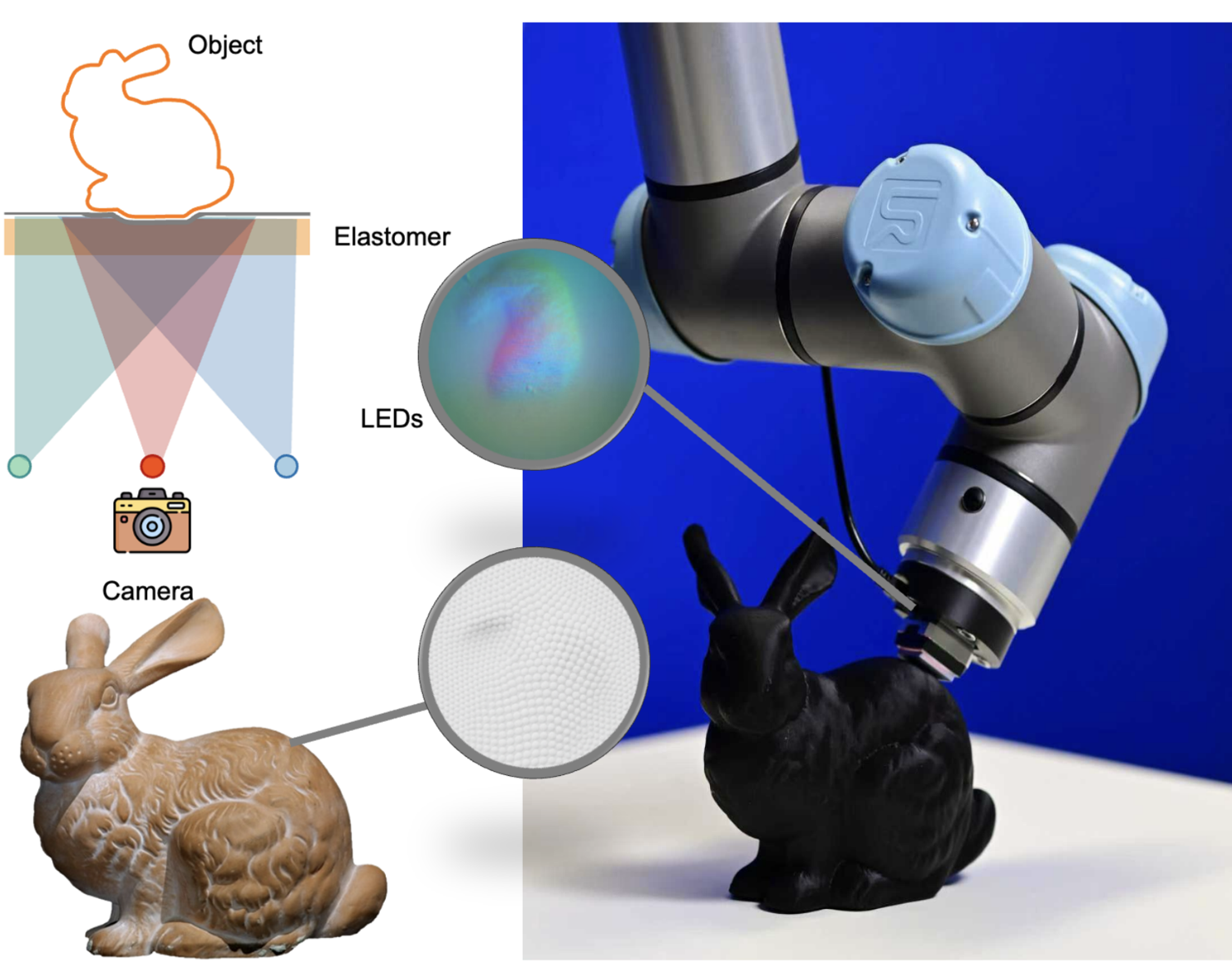
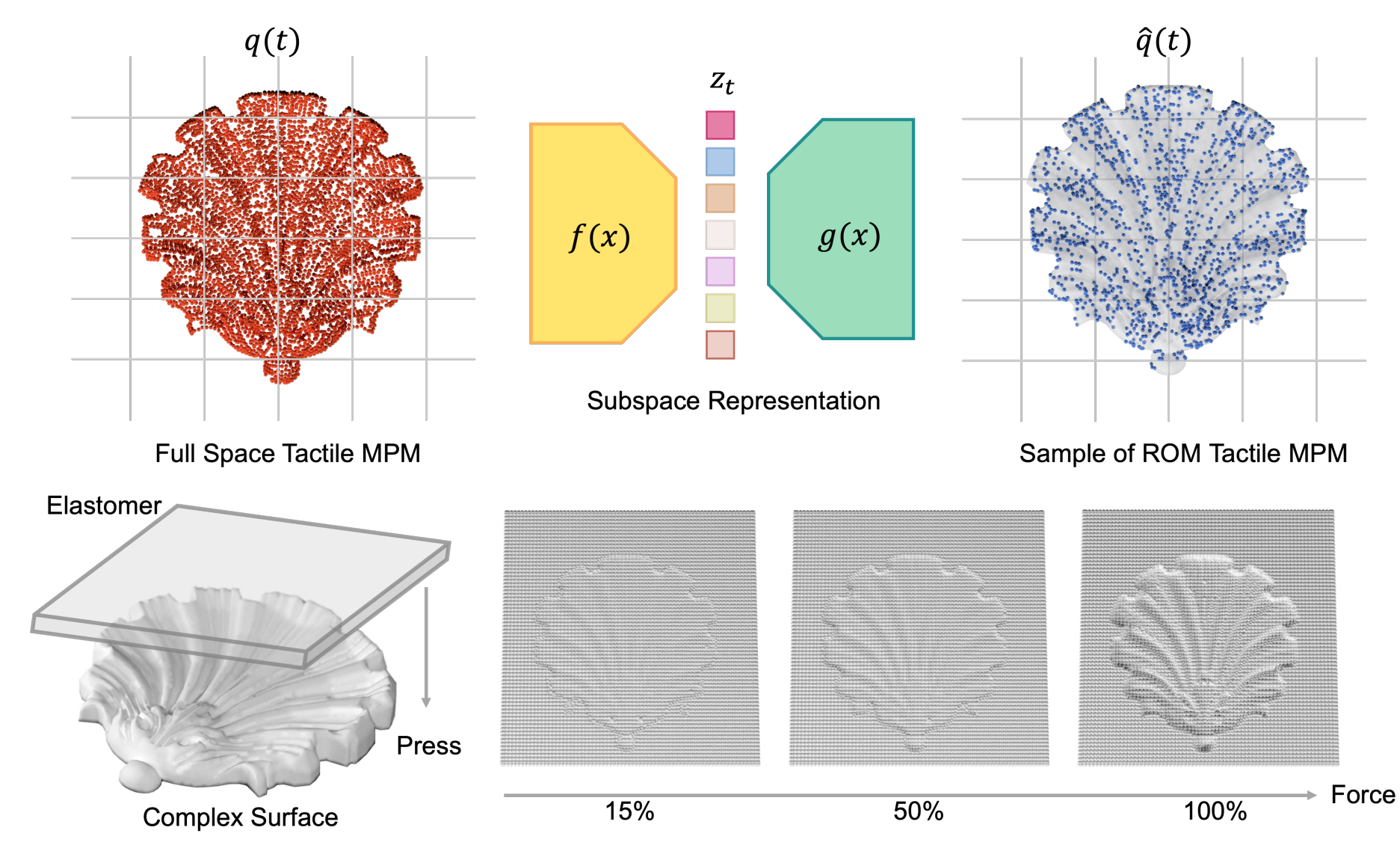
Our system first performs a coarse-grained MPM simulation to efficiently capture the global elastomer deformation. The resulting low-dimensional latent state is then fed into an implicit neural decoder trained on paired low- and high-resolution simulations, which reconstructs fine-scale tactile details such as wrinkles, ridges, and localized contact geometry. Finally, the recovered high-resolution surface is directly rendered into tactile depth images and 3D geometry, enabling physically grounded tactile perception at a fraction of the computational cost of full-resolution simulation.
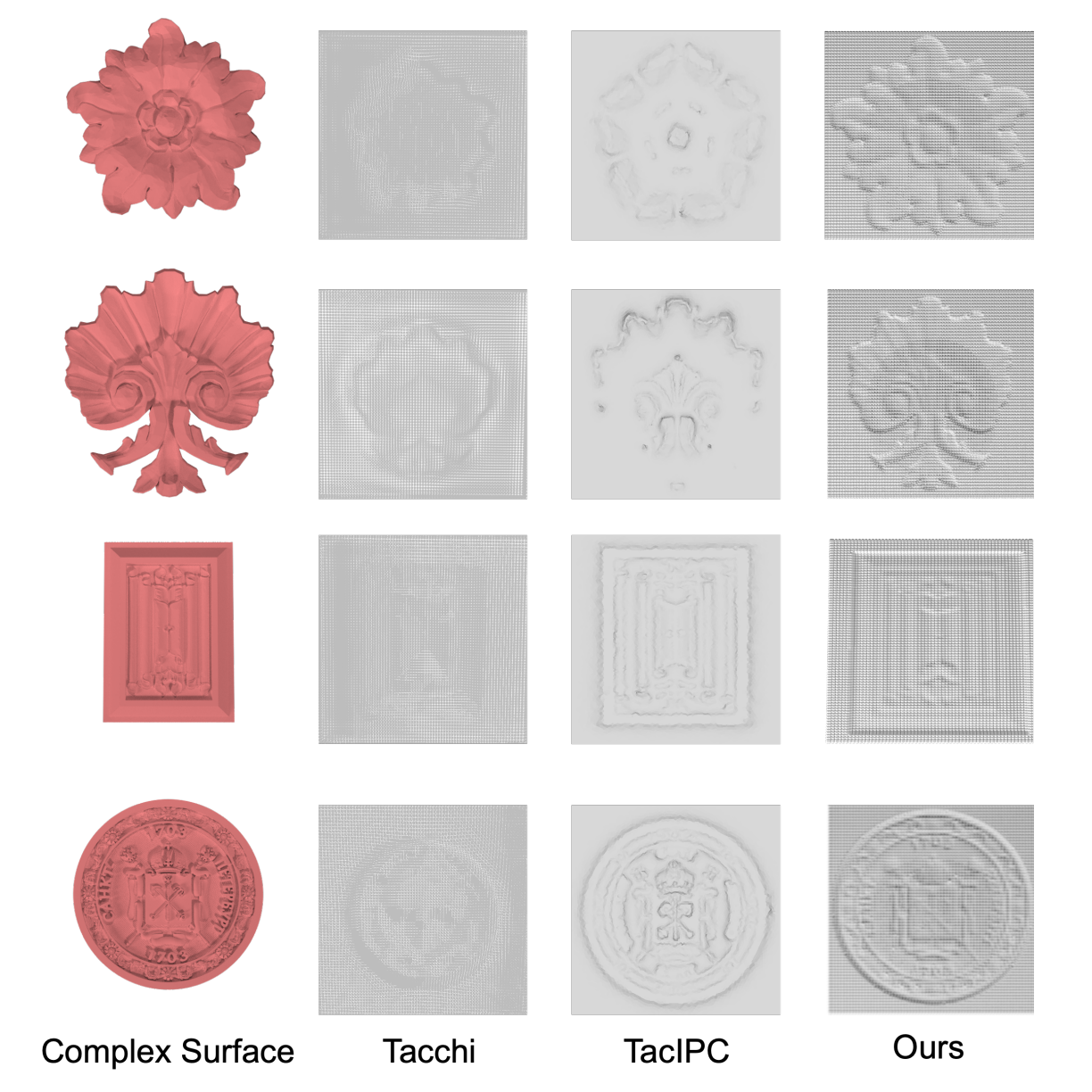
We compare Tacchi, TacIPC, and our reduced-order neural method under identical contact conditions and comparable element budgets. Our method better preserves local ridges, fine contact boundaries, and nonlinear surface deformation patterns, while the baselines exhibit oversmoothing or interpolation artifacts around high-curvature regions.
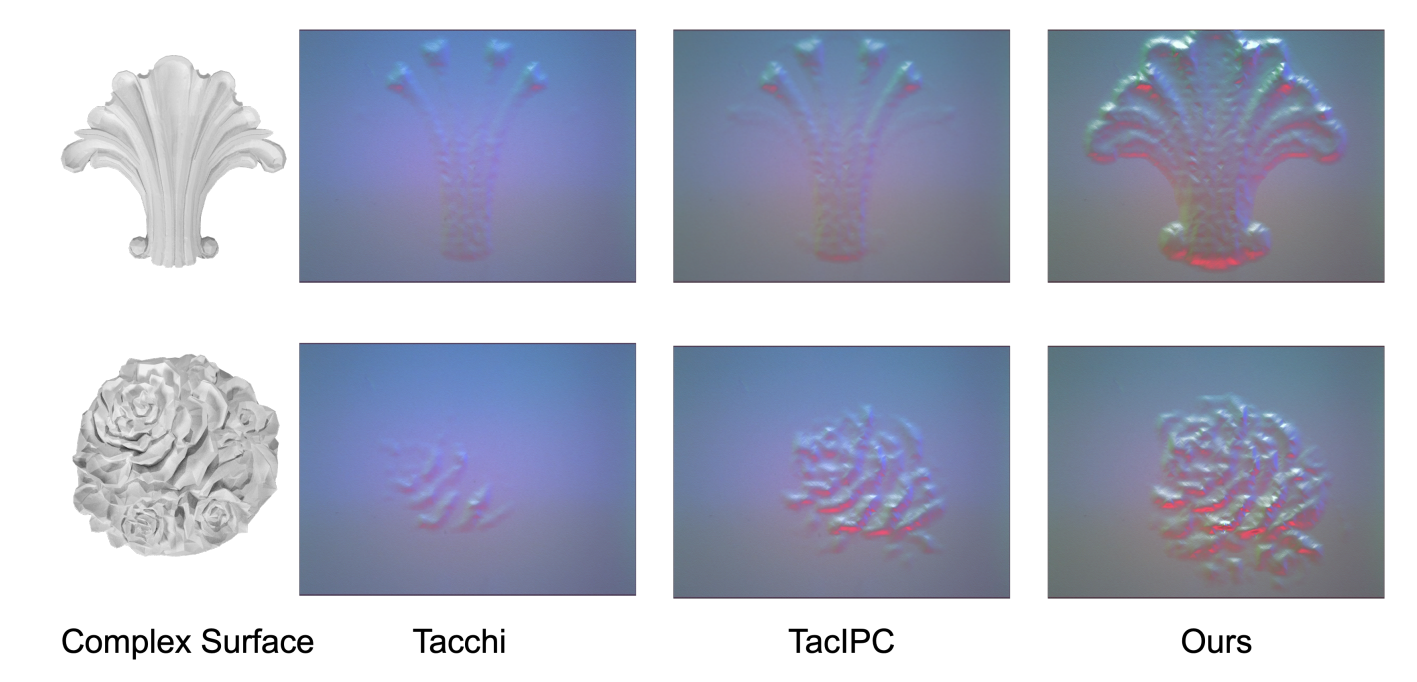
Given the same input geometry, our framework reconstructs high-fidelity tactile depth maps directly from reduced latent states. Compared with Tacchi and TacIPC, the rendered results retain sharper wrinkles and contact edges with fewer smoothing artifacts, demonstrating better geometric and photometric consistency for tactile image synthesis.
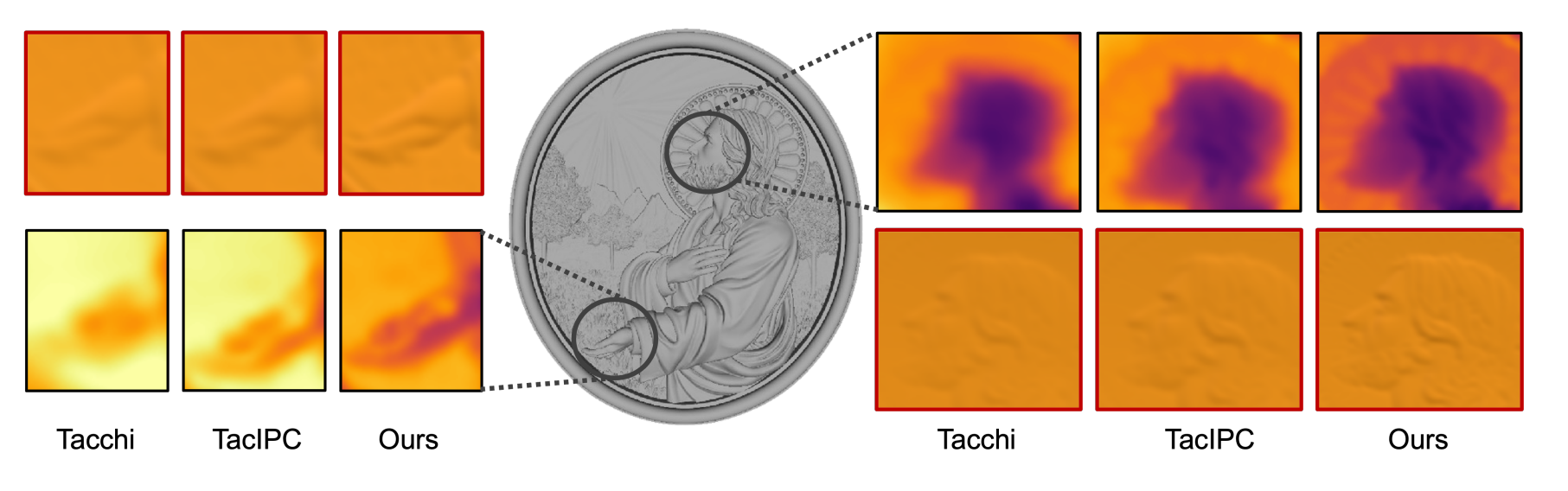
We evaluate depth prediction quality across simulators under identical poses. Our method yields more coherent depth structures and cleaner reconstructed 3D surfaces, reducing geometry distortion caused by over-smoothed tactile responses in prior methods.
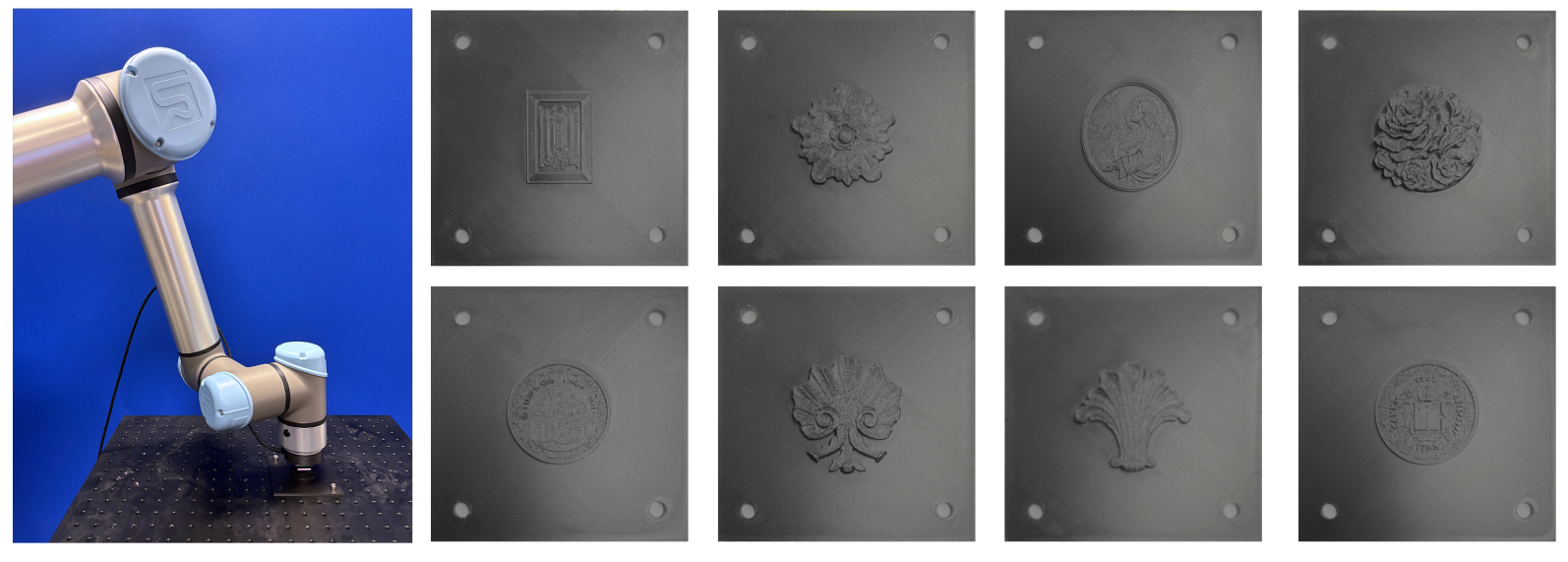
Our real-world setup uses a UR5e robotic arm with a GelSight Mini sensor and a custom set of complex 3D-printed objects. This hardware benchmark provides controlled tactile interactions for validating simulation fidelity and sim-to-real transfer.
We further validate our model using bunny-contact experiments: simulated elastomer deformation, rendered tactile observations, and robot-collected real sensor images show strong visual agreement, supporting physically grounded high-detail tactile perception (see top fig).